
The back office for clinics and small hospitals.Designed to register, schedule and dispense by lot and expiry,split each bill between payer and patient, issue the right tax document and calculate doctor fees.Built on PDPA principles from day one.
Paper files, spreadsheets, programs where everyone sees everything, and no record of who opened whose history.
How it's designed to workEach role sees only what it needs (a cashier never sees diagnoses), every read of health data is logged, non-treating doctors must state a reason, and the DPO can review afterwards.
Nobody can remember every allergy, and near-expiry lots sit behind the cabinet.
How it's designed to workWarns about allergies at the dispensing screen, picks the earliest-expiring lot automatically, and never offers expired or recalled lots for selection.
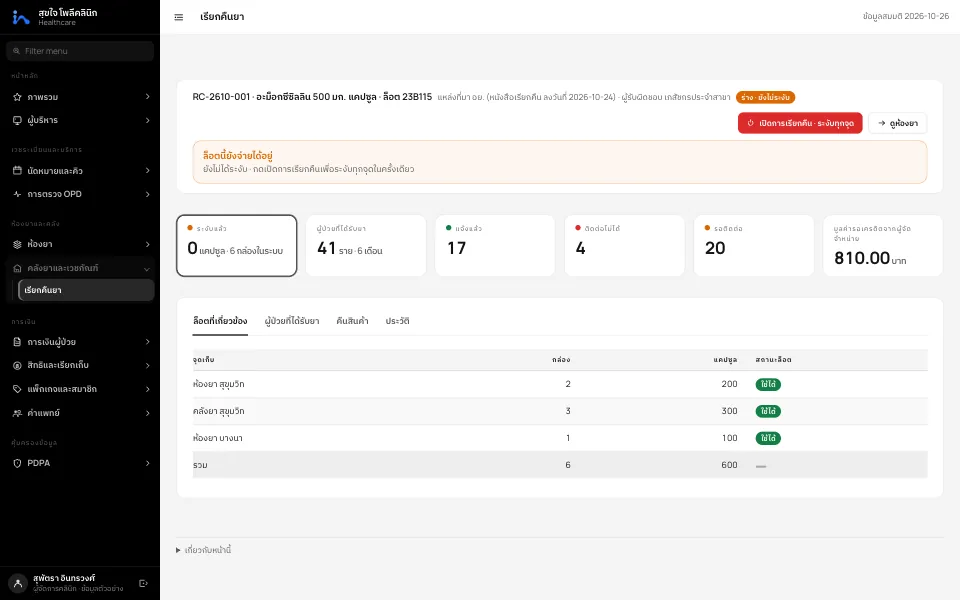
No way to find out which patients received a given lot.
How it's designed to workHolds a lot everywhere in one click and lists the patients who received it from the dispensing history.
Differences are worked out by hand, guarantee letters are forgotten, and short payments cannot be traced to a line.
How it's designed to workSplits payer and patient shares, checks guarantee letters before billing, matches remittances line by line, and follows up denied lines.
Calculated in spreadsheets every month-end, out of step with credit notes and insurer denials.
How it's designed to workAccrues doctor fees when the invoice is issued, adjusts for credit notes and denials by policy, lets doctors view their own statement, and pays by withholding or payroll.
Sessions are noted in a notebook, and cross-branch use puts revenue in the wrong branch.
How it's designed to workKeeps each patient's remaining entitlement per package, deducts it in the exam room, and recognizes revenue per session used.
Prototype screens in the Thai-language UI, with sample data.
Designed so diagnoses, prescriptions, allergies and ICD codes live encrypted in the clinic's own part of the system; accounting, stock and sales receive only item codes and amounts.
Designed so doctors see their own patients, pharmacists see prescriptions and allergies, cashiers see bills, and executives see totals without patient names.
Designed so insurer, corporate contract and patient each pay their share in one payment, with the payer share going straight into a claim batch.
Designed to dispense earliest-expiry first, with a register line and second signer for every controlled-drug movement.
Designed with rules per doctor, service category and payer scheme, calculating the surgeon and the anaesthetist separately.
Designed with an access log that cannot be edited or deleted, a DPO review screen, and data-subject request handling.
Quick check-in and queue, prescriptions sent from the exam room to the pharmacy, dispensing by lot, the right tax document on receipts, numbered medical certificates.
Multi-visit treatment plans with quotations, per-tooth procedures, dental lab work, deposits, dentist fees.
Courses and packages, remaining entitlements, instalments, membership and points, before/after photo consent, cross-branch course use.
Book the therapist and room together, per-session packages, no needless dispensing step.
Multi-doctor schedules, doctor fees, direct insurer billing with guarantee letters, remittance matching.
Bed map, inpatient admission with deposit or guarantee letter, nightly room charges without duplicates, treatment ledger, theatre, cost per case.
A single clinic with one to five doctors
Multi-branch clinics, aesthetic, dental, polyclinics
Small hospitals and multi-company groups
Capabilities describe design scope; performance figures are design targets, not measured results.
Pricing is agreed per project.