
Instalments, retention and advances in one flow.Designed to measure on site with photos and get quantities signed off,then bill each instalment with retention and advance recoupment worked out.Know every project's forecast profit each month.
Quantity surveyors merge quantities from many spreadsheets and work out retention, advances and deductions by hand; the owner sends it back.
How it's designed to workEach instalment is built from signed-off quantities, with the deduction order shown for checking before the invoice is issued.
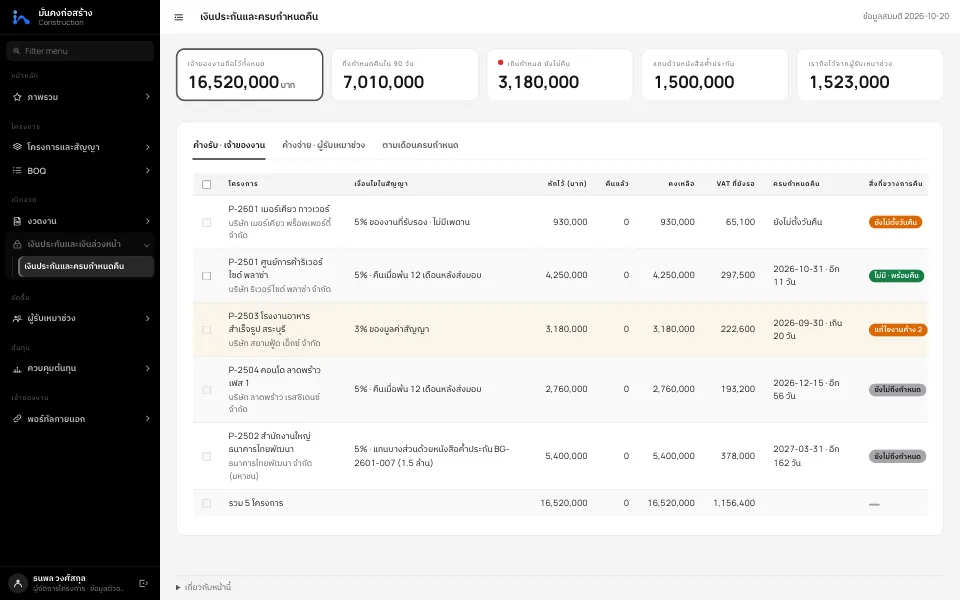
Nobody chases retention held by the owner once the warranty ends, and subcontractor retention is paid back even with defects still open.
How it's designed to workA retention register for receivable and payable, with due dates, a monthly list of items due, and no release to a subcontractor with open defects.
Material, labor, plant and subcontractor costs arrive late, with no commitments and no estimate at completion.
How it's designed to workTracks budget, commitments, actual cost and estimate at completion per project and work location, with forecast gross profit each month.
Work follows site instructions without paperwork, and its cost mixes with contract work.
How it's designed to workA clear status for each variation, cost of work done before approval always kept apart, and the value still at risk visible per project.
Retention, advances and back-charges are not fully deducted, and payment goes out before the work is accepted.
How it's designed to workPays only after a three-way match with accepted work, deducts retention, advances and back-charges, and allows payment holds.
K-factor is worked out in spreadsheets, and bid and contract guarantees do not show the remaining limit.
How it's designed to workA tender register with e-GP number, Factor F tables, K-factor per instalment with the indices used, and remaining guarantee limit per bank (Enterprise).
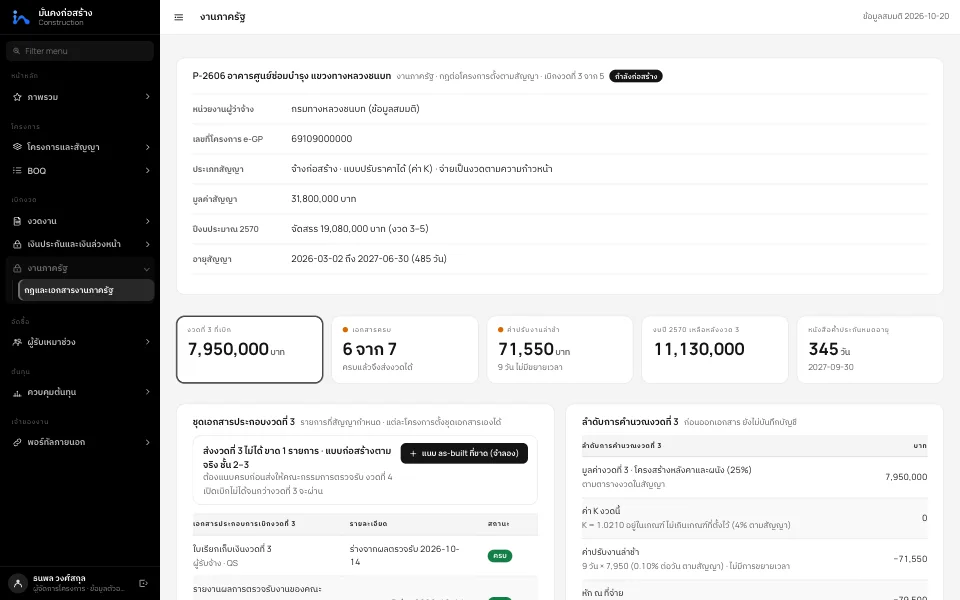
Prototype screens in the Thai-language UI, with sample data.
Designed so billing follows signed-off quantity per BOQ line, with the claimed-versus-accepted variance visible on every instalment.
Designed to calculate retention, advances, K-factor, damages and deductions in order and show them before the document is issued.
Designed to cover the owner side and the subcontractor side, with due dates, caps and release conditions.
Designed with a BOQ tree you can paste from a spreadsheet, unit-rate analysis from material, labor, plant and subcontract, and a total that must equal the contract value.
Designed to show budget, commitments, actual cost and estimate at completion per zone, floor and cost category.
Designed so open costs must be handled, retention and guarantees need release dates, and gross profit needs a second approver before a project closes.
Designed for billing instalments from signed-off quantities, retention and advance recoupment, variations, subcontractors and cost per floor and zone.
Designed for a tender register with e-GP, Factor F, bid, contract and advance guarantees, K-factor per instalment, and Buddhist-era dates.
Designed for back-to-back instalment billing with the main contractor, payment of lower-tier subcontractors, and set-off of service charges.
Designed for progress-based instalments the client accepts, deposits offset proportionally, and a system kept simple.
Designed for deposits, progress instalments, retention and material purchasing per client branch.
Home builders, interior fit-out and small contractors
Building contractors, specialty subcontractors and firms that tender for work
Large public works, company groups and joint ventures
Capabilities describe design scope; performance figures are design targets, not measured results.
Pricing is agreed per project.